Choosing the best oxygen tank cart for 2026 involves more than comparing prices or polished product photos. A reliable cart should move smoothly, support the tank securely, and fit the user’s daily routine. Imagine crossing a hospital corridor, entering a narrow doorway, or rolling over a slightly uneven sidewalk. Small design details can quickly become important.
This guide examines frame strength, wheel quality, handle comfort, tank compatibility, and overall stability. It also considers weight, folding features, storage needs, and cleaning requirements. Practical experience matters here. A cart may look strong online but feel awkward after several minutes of use. That difference deserves attention. Specifications should be checked against the manufacturer’s instructions, especially tank dimensions and weight limits. Do not assume universal compatibility.
Safety remains central. The best oxygen tank cart should help keep the cylinder upright and reduce unnecessary handling. Secure straps, balanced construction, and controlled movement can improve confidence for users and caregivers. Professional recommendations and current product documentation provide useful evidence, but real-world feedback can reveal weaknesses. Some reviews may be incomplete. That is worth remembering.
No single cart suits everyone. A compact model may work well indoors, while larger wheels may help across outdoor surfaces. The “best” choice depends on the cylinder, environment, mobility needs, and frequency of use. This comparison will highlight dependable options for 2026, while acknowledging that comfort and convenience are personal. A careful decision is better than a rushed purchase.
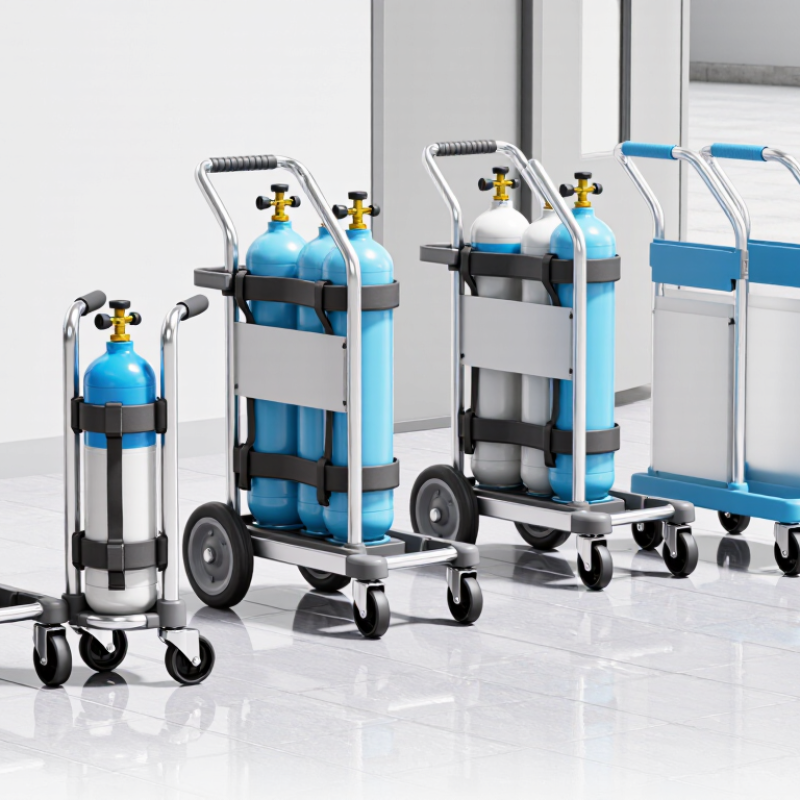
What Is the Best Oxygen Tank Cart for 2026?
The best oxygen tank cart depends on cylinder size, not appearance. E-size cylinders usually hold about 680 liters of oxygen. They suit many portable care routines and need a compact, steady cart. D-size cylinders commonly hold about 425 liters. Their carts should balance light weight with dependable support. M-size cylinders may hold roughly 3,450 liters. They require wider frames, stronger wheels, and secure retaining straps. Capacity figures can vary. Always check the cylinder label and cart specifications.
In daily use, I look for smooth movement, a low center of gravity, and handles that do not twist. E- and D-size carts may fit through narrow hallways more easily. M-size carts need extra clearance around doors and corners. A cart that looks strong can still wobble when loaded. I learned that the hard way during a storage-room check. Brakes, wheel size, and strap adjustment deserve careful inspection. The best choice is the cart that matches both cylinder capacity and the user’s strength.
Tips: Measure doorways before buying. Test the cart with an empty cylinder first. Confirm the holder diameter and maximum load. Keep the cylinder upright and firmly restrained. Check wheels and fasteners regularly. Do not rely on a product photo alone. A small mismatch can become a daily nuisance, or worse, a safety concern.
| Cylinder Size | Approx. Gas Capacity | Typical Full Weight | Typical Cylinder Dimensions | Recommended Cart Type | Suggested Minimum Payload | Best Use | Key Selection Features |
|---|---|---|---|---|---|---|---|
| D-Size | Approximately 425 liters of oxygen at a nominal 2,000 psi fill | About 18–25 lb (8–11 kg), depending on cylinder construction and fill pressure | Approximately 4.4 in diameter × 18–20 in high | Compact single-cylinder two-wheel cart with a retaining chain or strap | At least 35 lb (16 kg) | Short transfers, emergency equipment, ambulances, and compact clinical areas | Small turning radius, non-marking wheels, secure base cup, and lightweight frame |
| E-Size | Approximately 680 liters of oxygen at a nominal 2,000 psi fill | About 22–30 lb (10–14 kg), depending on cylinder construction and fill pressure | Approximately 4.4 in diameter × 25–26 in high | Tall single-cylinder cart with a low center of gravity and adjustable retaining strap | At least 40 lb (18 kg) | Home oxygen transport, patient transfers, clinics, and routine portable therapy | Wide wheelbase, anti-tip design, padded handle, and wheels suitable for indoor and outdoor surfaces |
| M-Size | Approximately 3,450 liters of oxygen at a nominal 2,000 psi fill | About 120–150 lb (54–68 kg), depending on cylinder construction and fill pressure | Approximately 9 in diameter × 50–52 in high | Heavy-duty upright cylinder truck with a large base, safety chain, and two or more wheels | At least 175 lb (80 kg) | Hospitals, medical gas storage areas, treatment centers, and longer-duration supply movement | Reinforced steel frame, pneumatic or industrial wheels, anti-tip support, and a load-rated securing chain |
| Mixed-Size Cart | Varies according to the number and size of cylinders carried | Calculated from the combined full weight of all cylinders and accessories | Varies; adjustable slots or removable base cups are common | Multi-cylinder cart with adjustable restraints and separated cylinder compartments | At least 1.25 times the expected combined operating load | Central supply rooms and facilities that regularly move D-, E-, and M-size cylinders | Adjustable restraints, lockable wheels, clear load labeling, and protection against cylinder-to-cylinder contact |
An E cylinder holds about 680 liters of oxygen when filled near 2,000 psi. That figure comes from standard medical-gas sizing tables and aligns with common cylinder specifications under ISO 9809. Actual usable volume may be lower. Pressure, temperature, regulator settings, and reserve requirements all matter.
The cart should fit the cylinder tightly, not merely carry its weight. Look for an adjustable securing strap, a stable base, and wheels that roll smoothly over door thresholds. A full E cylinder can weigh roughly 29 pounds before adding the regulator.
The U.S. Compressed Gas Association’s P-1 guidance emphasizes secure transport and preventing cylinder impact. A brake is useful indoors. Large wheels help on uneven pavement.
Flow rate changes the experience quickly. At 2 liters per minute, 680 liters suggests about 340 minutes theoretically. At 4 liters per minute, it falls to about 170 minutes. Real use is shorter because a safe reserve remains in the cylinder. That simple calculation is easy to overlook. I would not choose a cart by volume alone. Measure the cylinder diameter, handle height, doorway width, and the user’s actual route. Some carts look strong but become awkward on stairs, where a second person may still be necessary.
What Is the Best Oxygen Tank Cart for 2026?
A strong oxygen tank cart must match the real load, not only the cylinder count. OSHA 29 CFR 1910.253 requires cylinders to move on a suitable hand truck and remain secured. However, OSHA does not prescribe a specific cart load rating. That distinction matters. Weigh each cylinder, the restraint, and any attached equipment. Then compare the total with the manufacturer’s rated capacity. A practical purchasing margin of 25% to 50% is sensible, but it is an engineering precaution, not an OSHA requirement. NIOSH’s Revised Lifting Equation uses a 51-pound load constant for ideal manual lifting. That figure does not approve a cart rating. It does show why heavy cylinders deserve conservative handling controls. Ratings can mislead.
Tips: Check the cart plate before loading. Test it on ramps, door thresholds, and uneven flooring. Confirm that straps hold cylinders upright without contacting valves. OSHA also requires valve protection during movement and storage. Review the route, turning space, wheel condition, and braking performance. A cart rated for 300 pounds may perform poorly with a high center of gravity. I have seen capacity calculations ignore this detail. That is a mistake worth reconsidering. The U.S. Bureau of Labor Statistics’ 2023 Employer-Reported Injuries and Illnesses data continues to identify overexertion and bodily reaction among major injury categories, reinforcing the value of controlled movement. When documentation is incomplete, select the safer rating and record the calculation.
In clinics, wheel diameter directly affects control over thresholds, floor joints, and elevator gaps. Larger wheels usually roll more smoothly across uneven surfaces. However, they can increase the cart’s turning footprint. A practical assessment should measure turning radius, push force, and stability with a full cylinder. Test the cart beside beds, through narrow doors, and around crowded treatment rooms.
Brakes deserve equal attention. A brake should hold the loaded cart on a slight ramp without creeping. It should also release easily when staff wear gloves. Two locking swivel wheels may improve positioning, but poorly placed pedals can cause accidental contact. Secure restraints are essential. CGA P-1 guidance recommends keeping compressed-gas cylinders upright and properly secured. A chain or wide strap should limit movement without pressing against the valve.
The WHO Global Patient Safety Report 2024 states that one in ten patients experiences healthcare harm, with more than half considered preventable. That figure does not prove a cart caused an incident. It does show why small equipment decisions deserve formal review. Ask staff to score maneuverability during real transfers, not showroom demonstrations. A 125-millimeter wheel may work well on smooth flooring, yet fail at an old doorway. That is the uncomfortable part. No single specification replaces local testing, maintenance records, and repeated staff feedback.
What Is the Best Oxygen Tank Cart for 2026?
The best oxygen tank cart starts with fit, not appearance. Measure the cylinder’s diameter, height, valve clearance, and regulator space. A cart that rattles on uneven flooring can damage connections or create handling risks. NFPA 99, 2024 Edition, emphasizes stable storage and secure positioning for medical gas cylinders. Its guidance supports upright transport and protection from impact.
Safety should remain practical. Look for a wide base, locking wheels, a strong retaining strap, and a handle that stays comfortable during longer movement. The World Health Organization’s 2023 oxygen-access guidance highlights reliable oxygen delivery as a major clinical priority, especially where equipment is moved frequently. Durability also affects total cost. A stronger frame may cost more initially, but replacing bent wheels or cracked holders becomes expensive. Still, heavier is not always better. That assumption deserves review.
Tips: Compare the cart’s rated load with the full cylinder weight, not the empty weight. Test turning in a doorway. Check wheel locks on tile and carpet. Ask whether replacement parts are available for several years. The U.S. National Institute for Occupational Safety and Health stresses reducing manual-handling strain through better equipment design. A cart that looks simple may prevent awkward lifting. Do not ignore noise, either. Quiet movement matters in bedrooms and care areas. Review warranty terms carefully, because a low purchase price can hide higher lifetime costs.
Comparison of common oxygen tank cart designs using a 0–100 benchmark. Scores reflect typical tank fit, wheel stability, braking and handling, construction quality, maneuverability, and estimated three-year ownership cost. No company or brand data is included.
Best overall balance: The three-wheel all-terrain cart scores highest because it combines broad tank compatibility, stable handling, durable construction, and practical maneuverability. Four-wheel platform carts provide the strongest stability but usually have a higher purchase and ownership cost.
How to read the chart: A higher score is better. The total-cost score measures value over an estimated three-year ownership period, including purchase price, routine replacement parts, and expected maintenance.
| Cookie | Duration | Description |
|---|---|---|
| cookielawinfo-checkbox-analytics | 11 months | This cookie is set by GDPR Cookie Consent plugin. The cookie is used to store the user consent for the cookies in the category "Analytics". |
| cookielawinfo-checkbox-functional | 11 months | The cookie is set by GDPR cookie consent to record the user consent for the cookies in the category "Functional". |
| cookielawinfo-checkbox-necessary | 11 months | This cookie is set by GDPR Cookie Consent plugin. The cookies is used to store the user consent for the cookies in the category "Necessary". |
| cookielawinfo-checkbox-others | 11 months | This cookie is set by GDPR Cookie Consent plugin. The cookie is used to store the user consent for the cookies in the category "Other. |
| cookielawinfo-checkbox-performance | 11 months | This cookie is set by GDPR Cookie Consent plugin. The cookie is used to store the user consent for the cookies in the category "Performance". |
| viewed_cookie_policy | 11 months | The cookie is set by the GDPR Cookie Consent plugin and is used to store whether or not user has consented to the use of cookies. It does not store any personal data. |