
Why Choose barley grass juice powder for Wholesale? The answer begins with practical value, not fashionable packaging. Barley Grass Juice Powder offers a convenient way to supply concentrated green nutrition in a shelf-stable format. It fits smoothies, sachets, wellness blends, and functional beverage formulas. Its fine texture also supports easier portion control than fresh juice.
Dr. Yoshihide Hagiwara, a pioneer in barley grass research, often emphasized, “Barley grass is a food, not a medicine.” That distinction matters for responsible wholesale buyers. The product should support a balanced diet, not carry exaggerated promises. Reliable suppliers should provide batch-specific certificates of analysis, microbial testing, heavy-metal screening, and traceable sourcing. Ask where the barley was grown. Ask how quickly the young leaves were processed. Small details can affect color, aroma, solubility, and customer acceptance.
The category is not flawless. Bright green powder alone proves little. A dull batch may reflect age, processing, or storage problems. Even excellent powder can clump inside a humid warehouse. Buyers should inspect moisture levels, inner packaging, pallet conditions, and expiry dates. Taste matters, too. A grassy aroma may signal freshness, but harsh bitterness can reduce repeat orders.
Wholesale success depends on consistency. Retailers need dependable specifications, clear labeling, responsive documentation, and realistic delivery schedules. Barley Grass Juice Powder can become a strong product line when quality controls guide the purchase. It should never replace careful testing, transparent claims, or honest customer education.
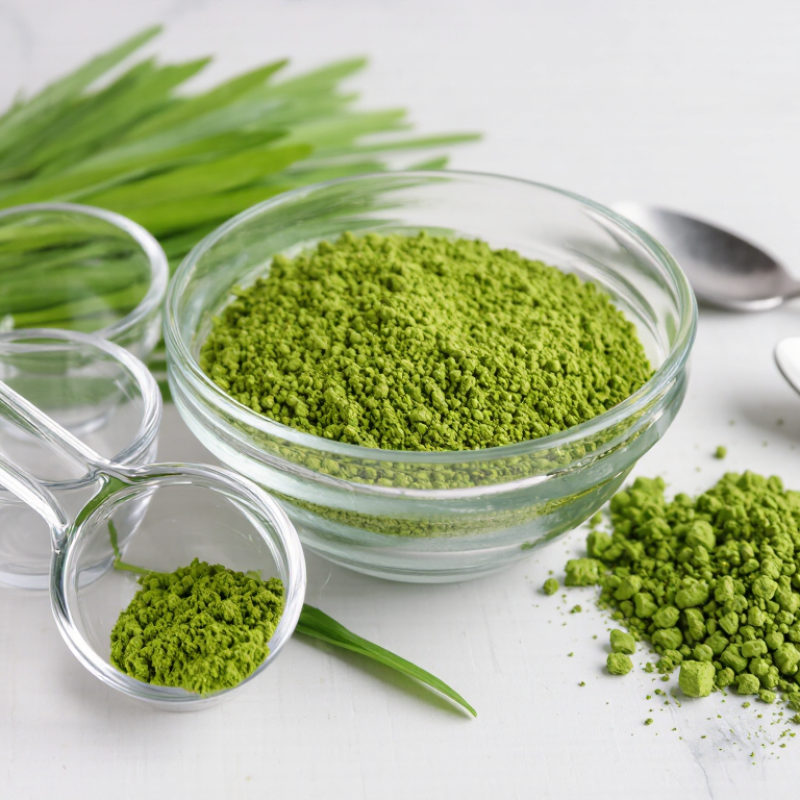
Barley grass juice powder is made from young barley leaves, not mature barley grain. The leaves are harvested before seed formation, pressed into juice, and dried into a fine green powder. Spray drying or freeze drying may be used, and each method can affect color, solubility, and nutrient retention. It usually mixes into water with a mild grassy taste.
This distinction matters for wholesale buyers. Whole-leaf powder contains more plant fiber, while juice powder generally contains less insoluble fiber and disperses more easily. USDA FoodData Central reminds us that nutrient values depend on the tested food form and serving size. A laboratory result for fresh grass cannot automatically represent dried juice powder. That mistake appears often.
FAOSTAT’s latest crop data place global barley production above 140 million metric tonnes annually. This supports broad agricultural availability, but it does not prove a finished powder’s quality. Cultivar, harvest timing, soil, processing temperature, and storage all influence the final specification. I would request a certificate of analysis for every lot, including moisture, microbiological limits, heavy metals, pesticide residues, and identity testing. A bright green color looks appealing, yet color alone is weak evidence. Supplier documentation can be incomplete, and that deserves scrutiny before large-volume purchasing.
Why Choose Barley Grass Juice Powder for Wholesale?
How Barley Grass Juice Powder Is Produced
Commercial production begins with carefully selected barley seedlings, usually harvested before the plant forms grain. At this stage, the leaves contain chlorophyll, minerals, and plant compounds valued in green-food products. FAOSTAT recorded about 155 million metric tons of barley production worldwide in 2022. However, grain volume does not guarantee suitable juice-powder material. Variety, soil conditions, irrigation, and harvest timing still affect quality.
The process is precise. Fresh leaves are inspected, washed with controlled-quality water, and drained quickly. They are then pressed to separate liquid juice from fibrous material. The juice usually undergoes filtration before low-temperature drying, often through spray drying or freeze drying. Rapid moisture removal protects color and improves shelf stability. The finished powder is milled, sieved, and packed in moisture-resistant containers.
Small details matter.
Codex Alimentarius’ General Principles of Food Hygiene recommends preventive hazard controls through HACCP-based systems. Many professional facilities also align production controls with ISO 22000 food-safety practices. Batch testing commonly checks moisture, microbial counts, heavy metals, pesticide residues, and identity markers. USDA grain reports estimated global barley output near 140 million metric tons for 2023/24, showing broad agricultural availability. Still, supply scale can hide inconsistency. Young-leaf crops may vary between fields, and excessive heat can dull the powder’s green color. A reliable wholesale specification should state harvest age, drying method, test limits, and traceability details.
How barley grass juice powder is produced through a controlled, low-temperature process.
Young barley grass is harvested before the plant develops mature stems. The material is washed, juiced, filtered, gently dried, milled, and packed. Low-temperature drying helps create a stable, concentrated powder while supporting consistent handling for wholesale applications. Processing times and temperatures may vary according to equipment, batch size, and product specifications.
Barley grass juice powder can provide several naturally occurring nutrients in a convenient, concentrated format. It may contain vitamins A, C, and K, along with folate and small amounts of B vitamins. Its mineral profile can include potassium, calcium, magnesium, iron, and zinc. The exact levels vary by soil, harvest stage, processing method, and storage conditions.
It also contains chlorophyll and plant compounds with antioxidant activity. These compounds help explain its green color and fresh, grassy taste. However, “green” does not automatically mean nutritionally complete. Barley grass juice powder should complement a varied diet, not replace vegetables, fruit, or medical care.
For wholesale buyers, reliable nutrient information matters. Ask for recent laboratory testing, allergen statements, microbiological results, and clear origin records. A transparent supplier should explain whether the powder comes from pressed juice or whole grass. That difference can affect fiber and nutrient concentration. Packaging also deserves attention. Light, heat, moisture, and oxygen may reduce quality over time.
The powder is easy to blend into smoothies, water, or formulated nutrition products. Still, taste and solubility can differ between batches. I would not judge quality by color alone. A darker green appearance may look appealing, but verified testing offers stronger evidence. Naked claims need careful review.
Why Choose Barley Grass Juice Powder for Wholesale?
Wholesale buyers need ingredients that are recognizable, practical, and easy to verify. Barley grass juice powder fits this demand through its fresh green color and convenient dry format. Grand View Research valued the global dietary supplements market at approximately USD 177.5 billion in 2023, with continued growth projected through 2030. This wider market signal supports interest in plant-based powder ingredients, but it does not guarantee sales.
Quality still decides repeat orders. A reliable supplier should provide batch-specific certificates of analysis, microbial testing, heavy metal screening, pesticide checks, and moisture data. Ask how the powder is processed, packed, and stored. A pale green pouch should not replace evidence.
Small details matter. A stable powder should pour smoothly, without damp clumps or unusual odors. It should also carry clear lot numbers and realistic shelf-life information. These details help wholesalers manage inventory and answer retailer questions.
The Nutrition Business Journal reported strong consumer interest in wellness products, yet purchasing habits remain sensitive to price and trust. That makes barley grass juice powder attractive for private-label blends, sachets, and smoothie products. Still, taste can be challenging. Some buyers may reject its grassy flavor. Sampling, careful formulation, and transparent labeling are necessary. I would not promise universal acceptance. Wholesale success depends on testing the product with real customers before committing to a large shipment.
| Evaluation Dimension | Barley Grass Juice Powder | Wholesale Advantage | Recommended Verification |
|---|---|---|---|
| Raw Material and Processing | Produced from the juice of young barley grass, followed by concentration and drying, commonly through spray drying. | Provides a consistent powdered ingredient that is easier to portion, blend, package, and transport than fresh juice. | Request the raw-material specification, process description, and batch production records. |
| Solubility and Dispersion | Generally disperses more easily in water than whole-leaf barley grass powder because much of the insoluble plant fiber is removed during juicing. | Suitable for drink mixes, sachets, smoothies, instant beverage blends, and powdered supplement formulas. | Check dispersibility, sedimentation, color, and flavor using the intended application formula. |
| Dietary Fiber Profile | Usually contains less dietary fiber than whole barley grass powder because the pressed juice does not retain most insoluble fiber. | Allows buyers to select a cleaner, juice-based ingredient when a lower-fiber beverage profile is preferred. | Confirm total dietary fiber and carbohydrate values through a product specification or laboratory report. |
| Moisture Control | Commercial powdered ingredients commonly target moisture levels of approximately 5% or below, although specifications vary by process. | Lower moisture supports powder flowability and helps reduce the risk of clumping during storage. | Verify moisture or loss-on-drying results for every production lot. |
| Powder Particle Size | Fine powders are commonly offered in approximately 80–100 mesh ranges, depending on the milling and sieving process. | Consistent particle size improves filling accuracy, blending uniformity, and packaging performance. | Confirm mesh size, particle-size distribution, and sieve test results. |
| Storage Requirements | Best stored in a tightly sealed package in a cool, dry, dark location away from heat, moisture, and strong odors. | Appropriate storage helps preserve color, aroma, powder flow, and overall product quality throughout the distribution cycle. | Review storage instructions, packaging barrier properties, and warehouse handling procedures. |
| Typical Shelf-Life Planning | Many dried vegetable juice powders are assigned shelf lives of about 18–24 months when unopened and stored under specified conditions. | Supports inventory planning, export logistics, private-label production, and larger purchasing cycles. | Use the approved shelf-life statement, stability data, and the manufacturing date shown on the documentation. |
| Quality and Safety Testing | Suitable wholesale specifications commonly include identity, microbiological limits, heavy metals, pesticide residues, and moisture testing. | Documented testing reduces quality risks when the powder is used in foods, beverages, or dietary supplement products. | Request a current certificate of analysis, microbiological report, heavy-metal results, and pesticide-residue report. |
| Color and Flavor | Typically presents a green color with a characteristic grassy, vegetal flavor. Color and taste can vary with harvest, drying, and storage. | Provides a recognizable plant-based profile for green beverage powders and functional food formulations. | Approve a retained sample and define acceptable color, odor, taste, and appearance ranges before bulk purchasing. |
| Packaging Options | Common wholesale formats include lined kraft bags, foil-laminated bags, fiber drums, and other moisture-barrier containers. | Flexible packaging options can accommodate different order volumes, shipping conditions, and repacking requirements. | Confirm net weight, liner material, tamper protection, pallet configuration, and export labeling requirements. |
| Regulatory and Labeling Considerations | Ingredient names, nutrition information, permitted claims, and required warnings depend on the destination market and final product category. | Early regulatory review helps prevent relabeling, customs delays, or unsupported marketing claims. | Check the destination country’s food or supplement rules and obtain documentation needed for import clearance. |
| Best-Fit Wholesale Applications | Common applications include powdered beverages, smoothie mixes, nutrition blends, capsules, tablets, and functional food products. | Broad application potential can support multiple product formats from one bulk ingredient. | Conduct pilot trials to assess dosage, flavor balance, solubility, stability, and compatibility with other ingredients. |
Note: Nutrient values, specifications, shelf life, and quality parameters can vary by harvest, processing method, packaging, and market requirements. Confirm all commercial data with a current certificate of analysis and product specification before placing a wholesale order.
Why Choose Barley Grass Juice Powder for Wholesale?
Barley grass juice powder can support a consistent wholesale product when quality remains stable. Buyers should examine more than a bright green color. Ask how the barley is grown, harvested, dried, and milled. Low-temperature processing may help preserve its natural characteristics, but suppliers should explain their actual method clearly. Request a recent certificate of analysis for each production lot. It should show moisture, microbiological results, heavy metals, and relevant pesticide screening. Vague documents are warning signs.
A reliable wholesale supplier can provide traceability from field records to finished packaging. Check the lot number, production date, shelf life, and storage instructions. A practical supplier should also offer a representative sample before a large order. Test its smell, texture, solubility, and flavor in your own process. Ask about minimum order quantities, lead times, damaged goods, and replacement procedures. Communication matters. If answers change between emails, pause before purchasing. I have found that fast replies do not always mean dependable service.
Tips: Compare two or three suppliers using the same checklist. Inspect sealed packaging for moisture damage or weak labels. Confirm that certificates come from qualified independent laboratories. Discuss temperature-controlled shipping when climate conditions require it. Keep written records of every promise. Small details matter. One overlooked storage instruction can affect an entire shipment.
| Cookie | Duration | Description |
|---|---|---|
| cookielawinfo-checkbox-analytics | 11 months | This cookie is set by GDPR Cookie Consent plugin. The cookie is used to store the user consent for the cookies in the category "Analytics". |
| cookielawinfo-checkbox-functional | 11 months | The cookie is set by GDPR cookie consent to record the user consent for the cookies in the category "Functional". |
| cookielawinfo-checkbox-necessary | 11 months | This cookie is set by GDPR Cookie Consent plugin. The cookies is used to store the user consent for the cookies in the category "Necessary". |
| cookielawinfo-checkbox-others | 11 months | This cookie is set by GDPR Cookie Consent plugin. The cookie is used to store the user consent for the cookies in the category "Other. |
| cookielawinfo-checkbox-performance | 11 months | This cookie is set by GDPR Cookie Consent plugin. The cookie is used to store the user consent for the cookies in the category "Performance". |
| viewed_cookie_policy | 11 months | The cookie is set by the GDPR Cookie Consent plugin and is used to store whether or not user has consented to the use of cookies. It does not store any personal data. |