
What Is a Dental Implant Torque Wrench?

A Dental Implant Torque Wrench is a hand-operated instrument used to apply a measured amount of rotational force when tightening implant components. It helps clinicians follow the torque value specified for a particular implant system or prosthetic screw. Many models include a calibrated scale or a mechanism that signals when the selected setting is reached. That small click can matter. Too little or too much force may affect the connection, so the wrench is not merely a more precise screwdriver.

In this guide, we will explain the wrench’s main parts, how torque settings are read, and why values can differ between manufacturers and components. We will also cover basic handling, cleaning, and calibration considerations. A number on a scale is useful, but it does not replace the product instructions or clinical judgment. And that distinction is easy to overlook. The correct setting depends on the specific implant connection and the manufacturer’s guidance, not on a universal value. Clinicians should verify their instrument’s condition and follow the applicable instructions for use. A worn or poorly maintained wrench may not deliver its intended force. Small details count.

For patients, understanding the tool can make discussions about implant treatment clearer, though the wrench itself is used by trained dental professionals. For clinicians and students, it offers a practical way to think about controlled tightening. The tool is precise, but not magical. Its readings deserve care—and, occasionally, a second look.
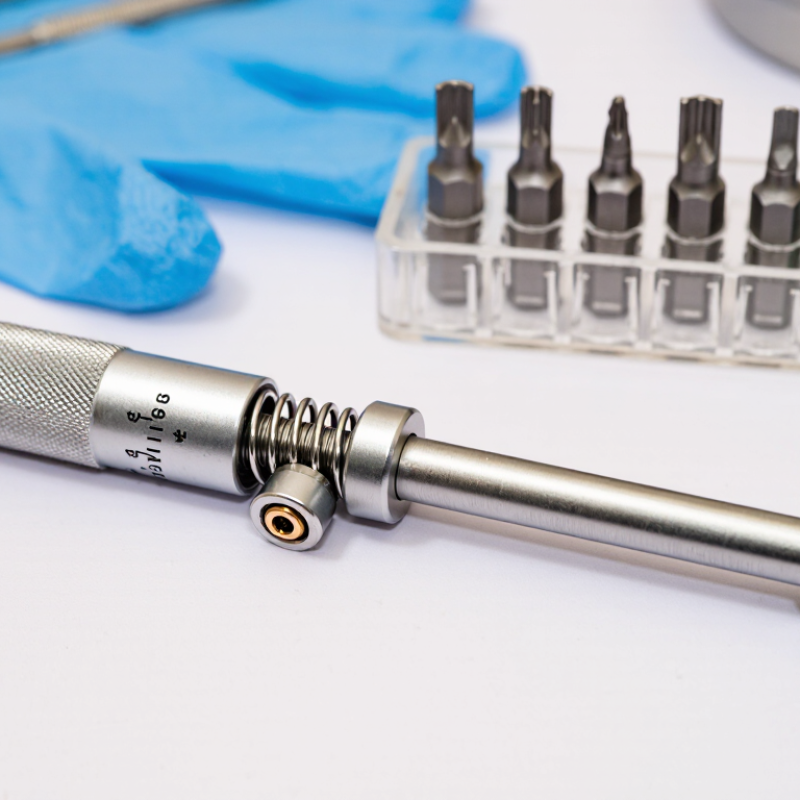
What Is a Dental Implant Torque Wrench?

Definition and Role of a Dental Implant Torque Wrench

What Is a Dental Implant Torque Wrench?

Definition and Role of a Dental Implant Torque Wrench

A dental implant torque wrench is a calibrated hand instrument that tightens implant screws to a measured rotational force, usually expressed in newton-centimeters (Ncm). It helps clinicians avoid under-tightening, which can allow screw loosening, and excessive force, which may damage components. The target is not a guess based on hand feel. Clinical implant literature commonly reports prosthetic screw settings around 20–35 Ncm, but the correct value depends on the component and its instructions. ISO 6789-2:2017 sets calibration and measurement-uncertainty requirements for hand torque tools; it does not establish one universal dental setting. A wrench can feel precise and still drift, so calibration and careful handling matter.

Tips: Check the component’s specified torque before use. Seat the driver fully, keep it aligned, and apply force smoothly until the wrench signals the set value. Avoid using a torque wrench as a general-purpose ratchet. Record calibration checks and replace worn or damaged instruments. Small details matter here. A rushed click is easy to misread.

Key Components, Calibration, and ISO 6789 Accuracy Requirements

A dental implant torque wrench applies controlled rotational force to an implant connection. Its head engages the driver, while a handle provides leverage and a scale, preset mechanism, or click signal indicates the target torque. Some designs use a spring-loaded mechanism; others display torque electronically. Small errors matter. A click can feel reassuring, but feel alone cannot confirm the delivered force.

ISO 6789-1:2017 specifies requirements and test methods for hand torque tools. For applicable Type II tools, its permitted indication deviation is commonly ±4% for certain classes; other classes have different limits. ISO 6789-2:2017 covers calibration and measurement uncertainty. These limits should not be assumed to apply automatically to every dental wrench: check the tool’s declared range and classification. Calibration should use a traceable torque tester, with readings taken at relevant points across the working range. Testing only near maximum torque can miss errors at lower clinical settings. Not just paperwork. Record the date, applied torque, measured result, and uncertainty, then follow the manufacturer’s service interval. A worn spring or contaminated mechanism may affect performance, even when the tool still clicks. Calibration reduces uncertainty, but it cannot correct poor handling or an unsuitable driver fit.

Typical Implant Screw Torque Values: Manufacturer-Specified N·cm Ranges

A dental implant torque wrench applies a controlled turning force, measured in newton-centimeters (N·cm). Its most important setting is not a universal number. It is the value specified for the particular implant connection and screw. Many restorative screws fall around 15–35 N·cm, while some systems specify values outside that range. Check the current instructions for use before tightening. Close is not good enough.

Do not confuse prosthetic screw torque with implant insertion torque. Insertion torque describes resistance as the implant enters bone; the abutment or prosthetic screw value describes how firmly that screw is tightened. They serve different purposes. A value suitable for one can damage another. On the tray, the wrench’s scale may look simple, but the connection details matter. Confirm the component, read the specified N·cm value, and use a properly maintained wrench. If the instructions are unclear, pause and verify them rather than guessing. I would not rely on a remembered setting; small differences can matter, and clinical judgment still has limits.

What Is a Dental Implant Torque Wrench?

Typical Implant Screw Torque Values: Manufacturer-Specified N·cm Ranges

A dental implant torque wrench applies a controlled tightening force, measured in N·cm. The bars show representative ranges commonly encountered in implant-system instructions: actual values vary by component and system. Always follow the instructions for the specific implant and component.

Clinical Use: Applying and Verifying Torque During Implant Placement

During implant placement, a torque wrench helps the clinician control rotational force rather than rely on feel alone. The implant driver should be fully engaged and aligned with the implant. Apply steady pressure, keeping the wrench as straight as the access allows. Stop when the instrument indicates the prescribed torque; do not add force just to make the implant feel more secure.

Use the torque value specified for the implant system and the clinical step. Insertion torque and the torque used to tighten a restorative screw are not interchangeable. Small details matter. Before use, check that the wrench is intact and within its calibration interval, and follow its cleaning and sterilization instructions. If resistance rises unexpectedly, pause and reassess the site, trajectory, and device rather than forcing rotation. A reading can help describe mechanical resistance, but it cannot confirm future osseointegration or replace clinical judgment. Record the relevant value and any unusual resistance in the patient record. Even experienced clinicians can be tempted to treat one number as a verdict; it is useful information, not the whole story.

Maintenance and Safety: Calibration Intervals and Over-Torque Risks

What Is a Dental Implant Torque Wrench?
Maintenance and Safety: Calibration Intervals and Over-Torque Risks

A dental implant torque wrench applies a measured tightening force, usually in newton-centimeters (N·cm). Its reading matters: too little torque can leave a connection unstable, while too much may damage screw threads, components, or the implant connection. ISO 6789-2:2017 describes calibration procedures and uncertainty reporting for hand torque tools, but it does not set one universal calibration interval. Follow the wrench manufacturer’s instructions and your clinic’s documented maintenance schedule. Recheck the tool after a drop, repair, or suspected inaccurate reading.

Over-torque is easy to underestimate. A wrench can feel normal even when its output has drifted, especially after repeated use or cleaning. Use the specified torque for the implant system, and stop if the wrench does not release predictably. Bench studies of implant torque-limiting devices have reported differences between set and delivered torque; results vary by device and test method, so a single correction factor is not reliable. That uncertainty is worth taking seriously.

Tips: Keep a calibration log with dates, results, and any repairs. Store and sterilize the wrench only as its instructions allow. If readings seem inconsistent, remove it from clinical use pending inspection. Calibration takes time, and it is tempting to postpone it; that is a weak point in many maintenance routines.

What Is a Dental Implant Torque Wrench? — Maintenance and Safety: Calibration Intervals and Over-Torque Risks
Topic Practical Information Maintenance or Safety Action
Purpose A dental implant torque wrench applies a controlled rotational force when tightening compatible implant components, such as an abutment screw. Use the wrench only with compatible components and according to the applicable instructions for use (IFU).
Torque units Torque is commonly specified in newton-centimeters (N·cm). The required value depends on the specific implant component and procedure. Check the component’s prescribed torque value before use. Do not rely on a generic value for all implant systems.
Calibration interval There is no single calibration interval that applies to every wrench. The interval may depend on the manufacturer’s guidance, device design, and frequency of use. Follow the IFU and the practice’s documented maintenance policy. If the IFU does not specify an interval, ask the manufacturer or an authorized service provider. An annual interval may be adopted as an internal policy, but it is not a universal requirement.
When to check accuracy Accuracy can be affected by wear, repeated use, damage, or improper handling. Arrange inspection or calibration if the wrench is dropped, damaged, behaving inconsistently, or outside its scheduled service interval. Keep any calibration or service record with the device log.
Calibration method Calibration or torque verification should be performed with suitable test equipment by a qualified service provider or as directed by the manufacturer. Do not estimate calibration accuracy by feel or adjust the mechanism unless the device instructions explicitly permit it.
Over-torque risk Applying more torque than specified may damage or deform a screw or component, strip threads, or make later removal difficult. The exact risk depends on the component and clinical situation. Use the prescribed torque setting and a controlled technique. Stop if the wrench does not operate normally; do not compensate by applying extra force.
Under-torque risk Torque below the specified value may leave a connection inadequately tightened, potentially contributing to loosening or mechanical complications. Confirm the setting and follow the component-specific tightening sequence. Do not assume that a hand-tight connection has reached the required torque.
Use and handling Wrenches may have specific operating, cleaning, sterilization, storage, and reset requirements. Follow the device IFU for reprocessing and storage. Avoid using the wrench as a general-purpose lever or applying force beyond its intended operating range.
Documentation A maintenance log can record the device identifier, inspection or calibration date, service provider, and next review date. Keep records current and remove a damaged or overdue wrench from clinical use until it has been assessed according to policy.
Clinical note: Component-specific torque instructions and the device IFU take priority. This table is general maintenance information and does not replace professional judgment or manufacturer guidance.
Go to Top